
The patch tsunami
For nearly 25 years, Patch Tuesday gave IT teams a predictable stream of patches to manage. In 2026, AI turned that stream into a tidal wave that threatens to overwhelm the organizations that can’t adapt.
For IT administrators, the second Tuesday of the month has had a familiar rhythm for almost a quarter century. Microsoft publishes its monthly “Patch Tuesday” security updates, and IT teams figure out which ones apply to them, test them, and roll them out.
The consistent number of patches and metronomic cadence over decades have given organizations a framework for planning, testing, and deployment, and it’s been such a useful date in the calendar that many other vendors adopted the second Tuesday of the month to issue new fixes too.
It was so predictable it was almost dull, and that was good for our collective security. But in the space of a few short months, Patch Tuesday’s predictability has disappeared.
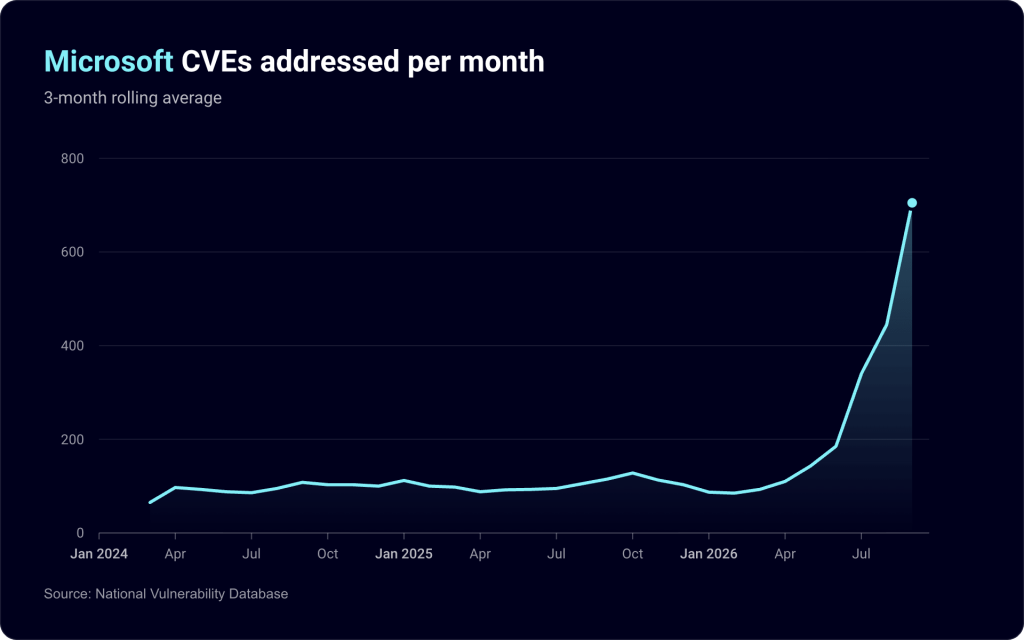
Since May 2026, the number of patches released by Microsoft and other vendors has soared. September’s second Tuesday addressed 998 CVEs. A year ago, it was 96.
The cause is a new generation of AI models, like Anthropic’s Mythos.
Anthropic announced Claude Mythos Preview in April, describing it as an AI model so powerful that it could “reshape cybersecurity.” Instead of releasing the model to the public, the company announced Project Glasswing, a partnership with major software vendors like Microsoft and the Linux Foundation, which would use it to “secure the world’s most critical software,” before similarly powerful AI tools fall into the hands of cybercriminals.
The precipitous increase in patches and ominous pronouncements from organizations like the UK AI Security Institute and the Five Eyes intelligence agencies have since silenced dissenting voices that dismissed the announcement as marketing hype.
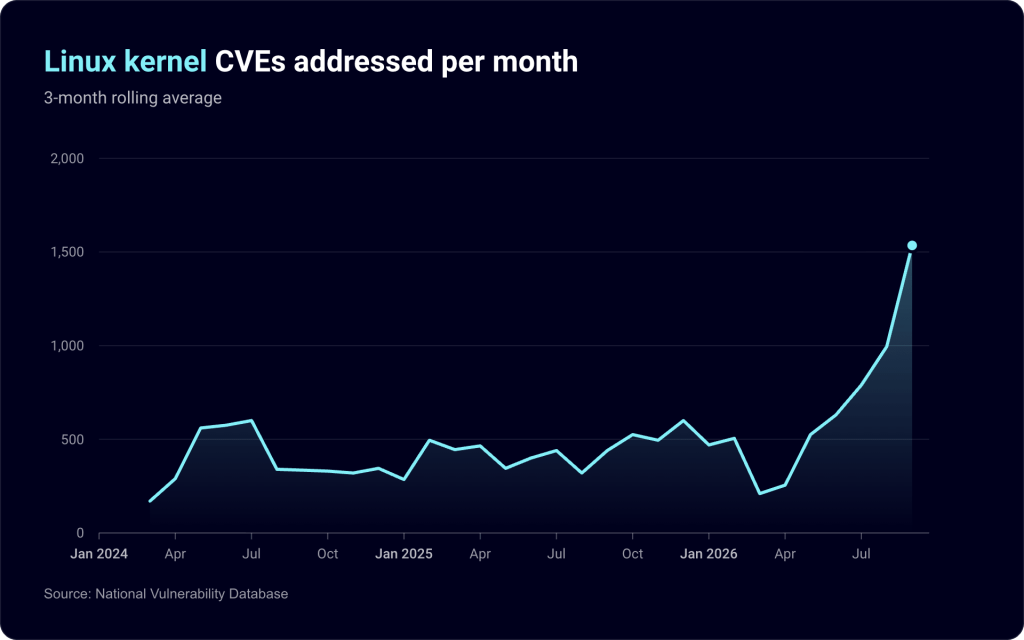
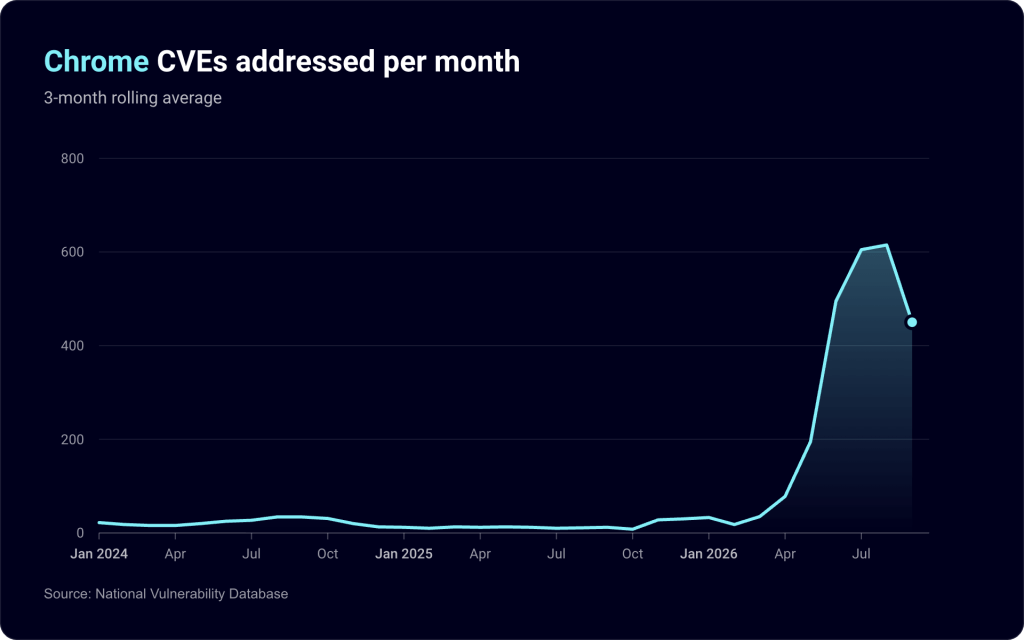
After 5 months, the effects of Project Glasswing, and OpenAI’s equivalent, Daybreak, are clear: the volume of vulnerability information entering the defensive ecosystem is exploding.
By September 2026, the three-month rolling average of patched Linux kernel CVEs had tripled year over year, and the Chrome browser had seen an astounding 36x increase.
In the long run, this is good for security. There are only so many software flaws to be found, and eventually, they’ll be fixed and software everywhere will be much harder to exploit.
For the people responsible for keeping production systems running, however, there is another side to this story. AI has made vulnerability research cheaper and faster sooner than it’s made patch deployment cheaper and faster.
Every vulnerability an advanced AI model finds becomes somebody’s change request, and security only improves when those change requests are executed. So, while AI can scale rapidly to discover vulnerabilities for vendors, their customers are still wrestling with maintenance windows, critical applications, fragile dependencies, regulatory requirements, employees, and customers.
In the last 4 months, IT staff conditioned to the well-established rhythms of Patch Tuesday have had to learn an entirely different tune.
Ryan Powell, ThreatDown Vice President, IT and Security, says that companies with automated patching systems are better placed to cope with the sudden increase in patch rates, but even then, more patches still means “more testing, validating, and more pushing, which increases operational overhead,” as well as friction for end users, and “increased operational risk as a result of all the changes introduced to the environment.”
Even before Mythos, patching capacity was showing signs of strain. Verizon’s 2026 DBIR found that in 2025, 35% of vulnerabilities known to be actively exploited were still unpatched after 28 days. It concluded that “there appears to be a ceiling, and the data suggests diminishing returns at current resource levels.”
The teams that were already struggling to keep up in 2025 are now facing a Patch Tuesday 10 times larger than last year’s. If they can’t adapt quickly enough, they will fall behind on their obligations, their patch queues will grow, and the time their systems are vulnerable will increase.
And that part of the story is the easy part.
Keeping endpoint applications like Chrome and Microsoft Office updated is only one part of the problem. Endpoint applications are highly visible. Administrators generally know where they’re deployed, and there are well-oiled systems for updating them.
But not every patch hits an endpoint. Software like OpenSSL, the ubiquitous open-source library for secure communications, is seeing the same explosion in vulnerability discovery. OpenSSL isn’t an application: it’s infrastructure. It’s incorporated into everything from endpoint applications and security tools to network appliances and embedded products, and it’s often instrumental to an organization’s security.
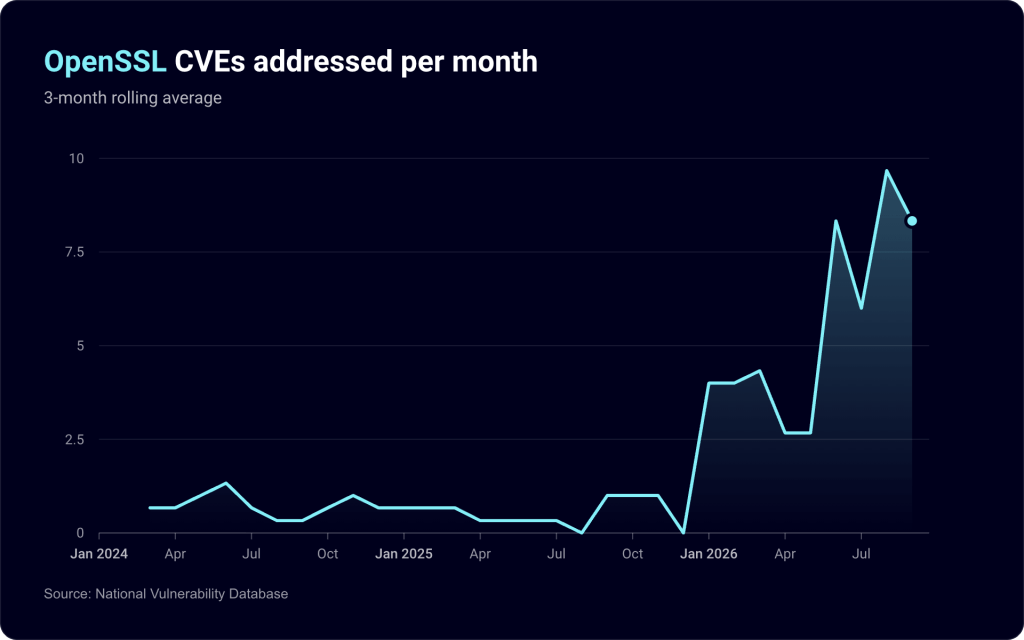
For example, organizations that use Netgate firewall appliances wouldn’t normally patch the OpenSSL library on their firewall directly. The firewall’s pfSense operating system includes OpenVPN for VPN functionality, and OpenVPN relies on OpenSSL for encryption.
Attackers can begin studying an exploitable OpenSSL flaw as soon as a patch becomes public. But the benefit of that patch won’t reach a vulnerable organization until it’s passed through the testing and release processes of downstream vendors, and then through its own change-control process.
The delay can be substantial. When OpenSSL fixed CVE-2022-0778 in March 2022, Synology shipped fixes for some of its products within weeks, but updates to its VPN and router products didn’t arrive for another 5 months.
Mythos-class AI isn’t just a challenge to IT teams. It’s also going to test every step in the software supply chain.
For 23 years, Patch Tuesday gave IT teams something security rarely offers: predictability.
AI is taking that away.
The long-term result will be more secure software, but getting there will mean finding vulnerabilities and fixing, testing, and deploying patches at a pace the industry has never had to sustain before.



Sign up to get the latest threat intelligence.
Subscribe to newsletter